

Panchi's famous, but the internet is wrong about him
insights on the viral orphan monkey from a primate behaviorist


Panchi is okay, y’all.
Your concern is valid, but let me be the one to reassure you—Panchi is actually a success story.
And I’ll tell you why, as a primatologist who’s spent over a decade studying the exact social behavior we’re witnessing in Panchi’s monkey group.
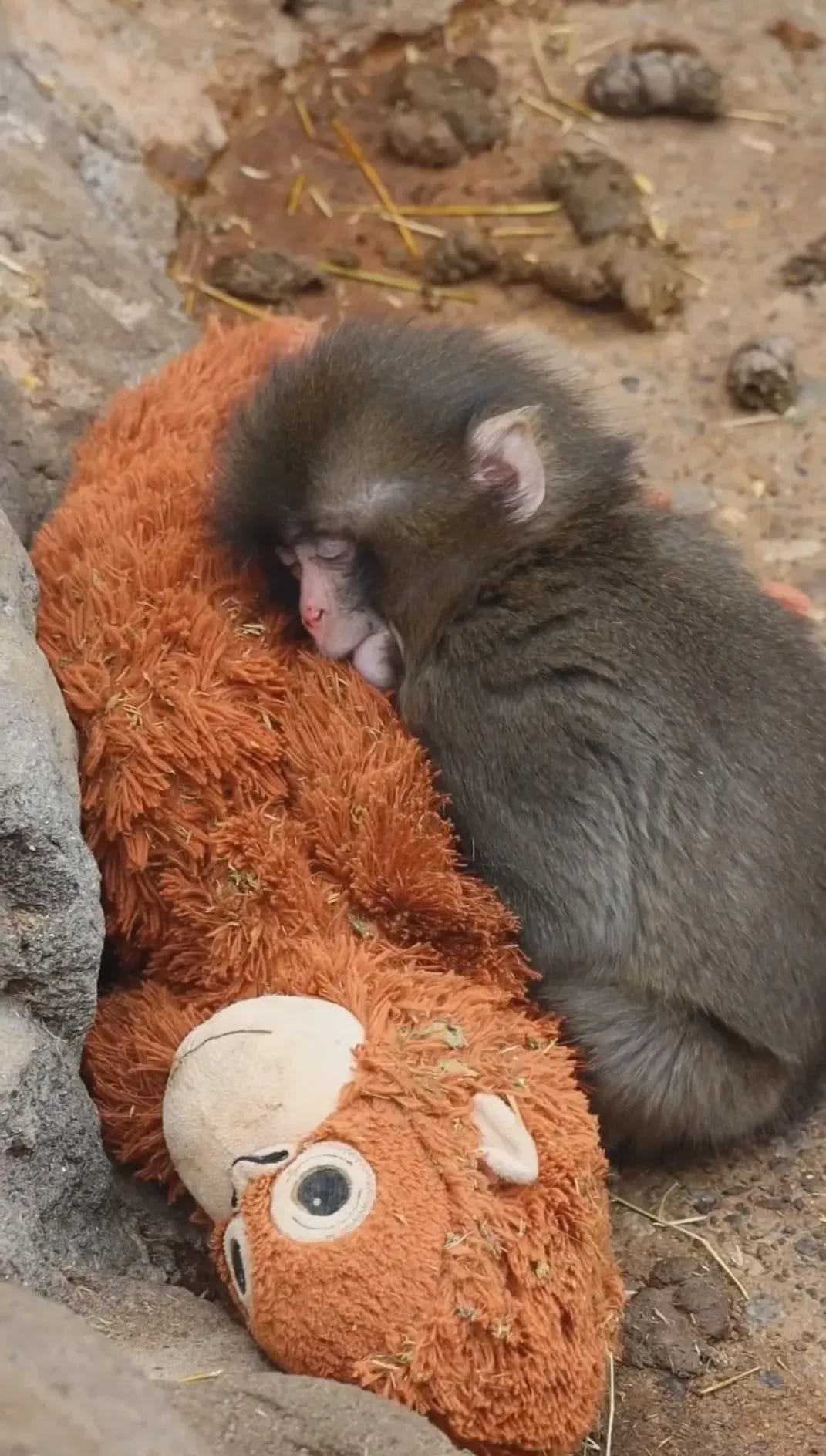
For those of you who haven’t seen this darling fluff ball online, Panchi-Kun (also known as “Punch”) is a six-month old Japanese macaque monkey who lives at the Ichikawa City Zoo in Japan. He’s the latest international reality star—for good reason.
First, I want to validate that I see you, reader. Sweet baby monkey, bullied and swiped at by his peers, ostracized to the edges of the social group.
How. Dare. Those. Monkeys. Bully. A. Baby.
It’s painful to watch, but that’s only because you’re human and placing human social norms upon a species that’s simply… not human. There’s room for empathy, of course, but what we’re seeing with Panchi is actually a massive success story, not a sad tale of a bullied baby.
So let me acknowledge your immediate reaction of pity and fury, and second, explain a bit about what’s going on in Panchi-Kun’s social group.
Panchi’s Story
Panchi was abandoned by his mother at birth, something that’s pretty rare in this species. It’s not unheard of, and thanks to controversial research in the past (cough Harry Harlow cough), we do know how to care for abandoned macaque infants, otherwise known as “hand-rearing” monkeys.
In Panchi’s case, when it was clear his mother rejected him, caretakers at the zoo stepped in and raised Panchi themselves, as is protocol for abandoned infant macaques.
I can’t speak to why Panchi was rejected by his mom. Usually, those of us working with nonhuman primates like to think there’s a reason infants are rejected by their mothers. Something wrong with the infant, something wrong with the mother. Often it’s got to be explained away as “she knows something we don’t”. As is many parts of the birth and postpartum experience—for humans and monkeys—, there’s not a clear answer.
So before you wave pitchforks at Panchi’s birth mom, remember that she’s just trying to be a monkey too. Her abandonment of Panchi wasn’t malicious, it just… was.
Orphaned monkeys and adoption
Panchi was introduced to the Japanese macaque social group at the Ichikawa City Zoo around the end of January of this year, close to his six-month birthday.
This six-month mark is key. Around six months of age, macaque babies become more independent, spending less time clinging to and nursing from their mothers. This the age in which we see many macaque mothers encouraging their infants to forge their own relationships and forage for their own food. Mom may continue nursing the infant intermittently for another six months, but we can think of this time period as the transition from toddler to juvenile—the tween years, if you will.
This six-month mark also coincides with mom gearing up for the mating season, the time period in which she could get pregnant with her next infant.
It’s important to pause here and note: Japanese macaques are seasonal breeders. This means all the females who are going to reproduce that year get pregnant at the same time and give birth around roughly the same time.
In Panchi were born at a primate research facility in which hundreds of mothers give birth each breeding season, his story may have been much different. If he was born in a facility where another mother had lost her infant—either given birth to a stillborn baby, or a baby who didn’t live beyond the first few hours/days of life—Panchi likely could have been given to an adoptive mother.
Typically, in macaque species, if a mom has recently given birth, she’ll fairly readily accept an infant that’s not hers.
For Panchi and his social group, it’s probabilistically slim that any mothers out of the 60ish monkeys in the social group gave birth and lost their infant at the same time as when Panchi was born.
All that to say, without an adoptive mother as an option, the next best option for Panchi was to be hand-raised by zookeepers.
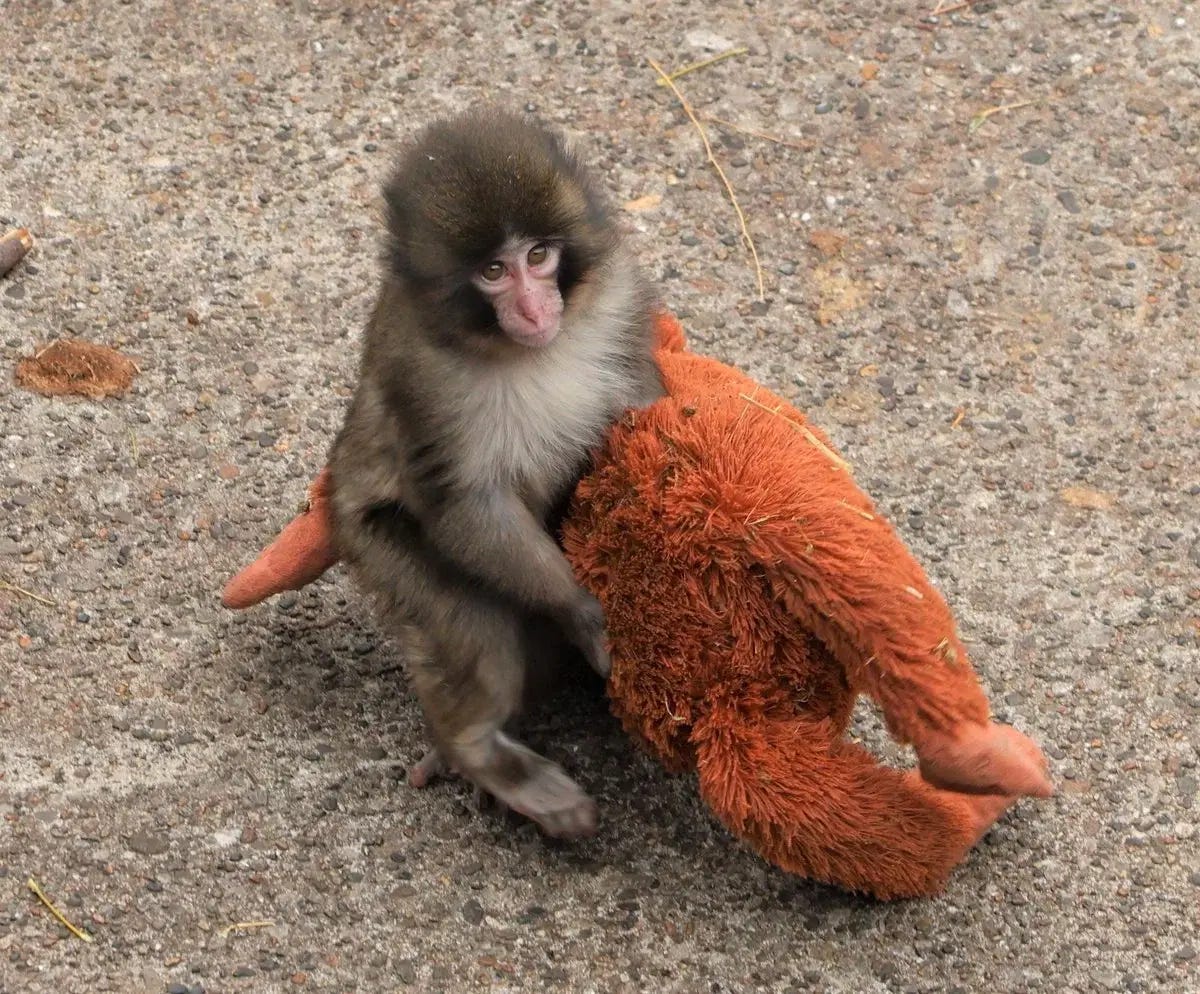
As we know well from previous studies, infants need a soft warm thing to cling to in order to feel safe and secure—not unlike a human infant holding onto their “lovey” or favorite stuffed animal plush.
Enter DJUNGELSKOG
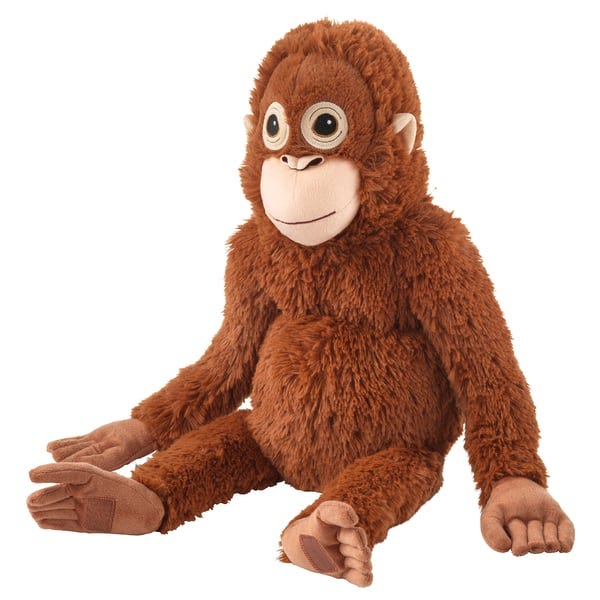
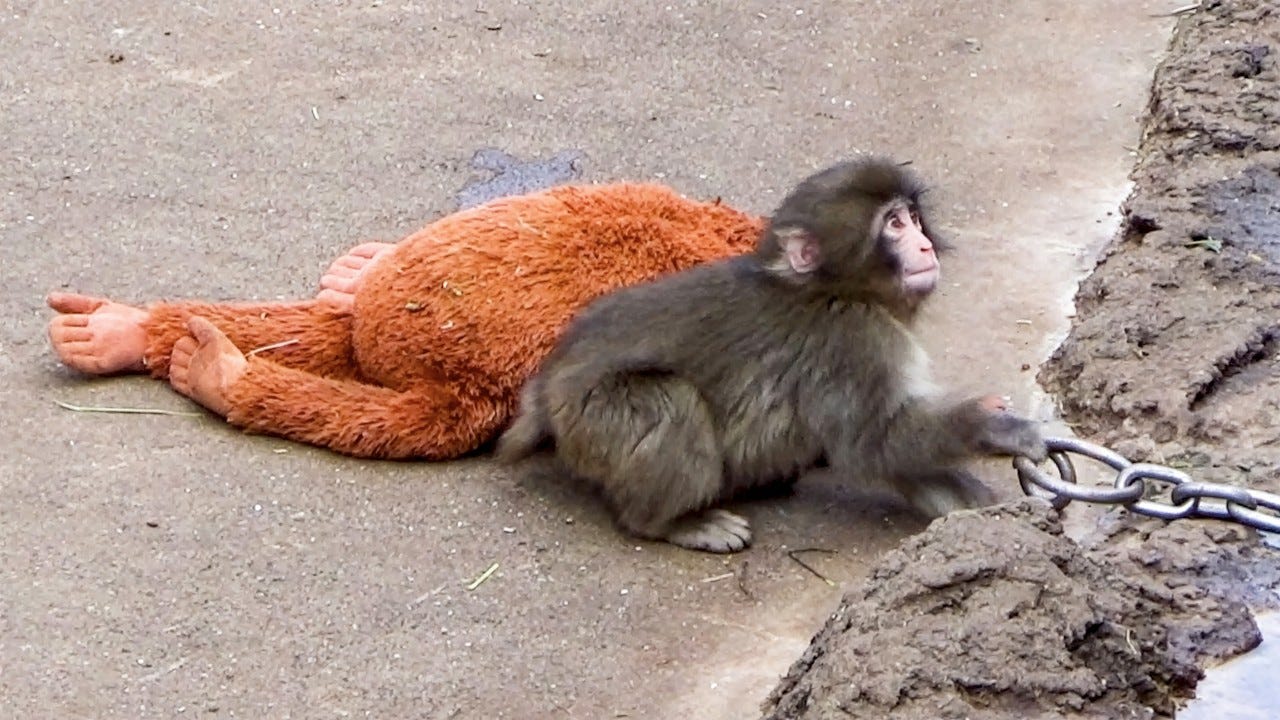
DJUNGELSKOG, IKEA’s soft plush orangutan was given to Panchi to serve as his comfort item/surrogate mother. Presumably, when Panchi wasn’t being actively cared for by a human, he was stationed with his orangutan, whom he formed an attachment to.
Notably, my toddler has his own DJUNGELSKOG. Come on, I’m a primatologist. Of course we have one.
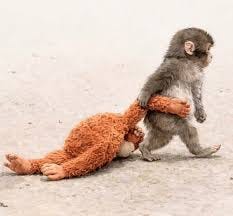
When it came time to introduce Panchi to the full social group, it makes sense that they’d allow him to take his orangutan with him, to provide a stable home base for Panchi to return to as he broadens his social network.
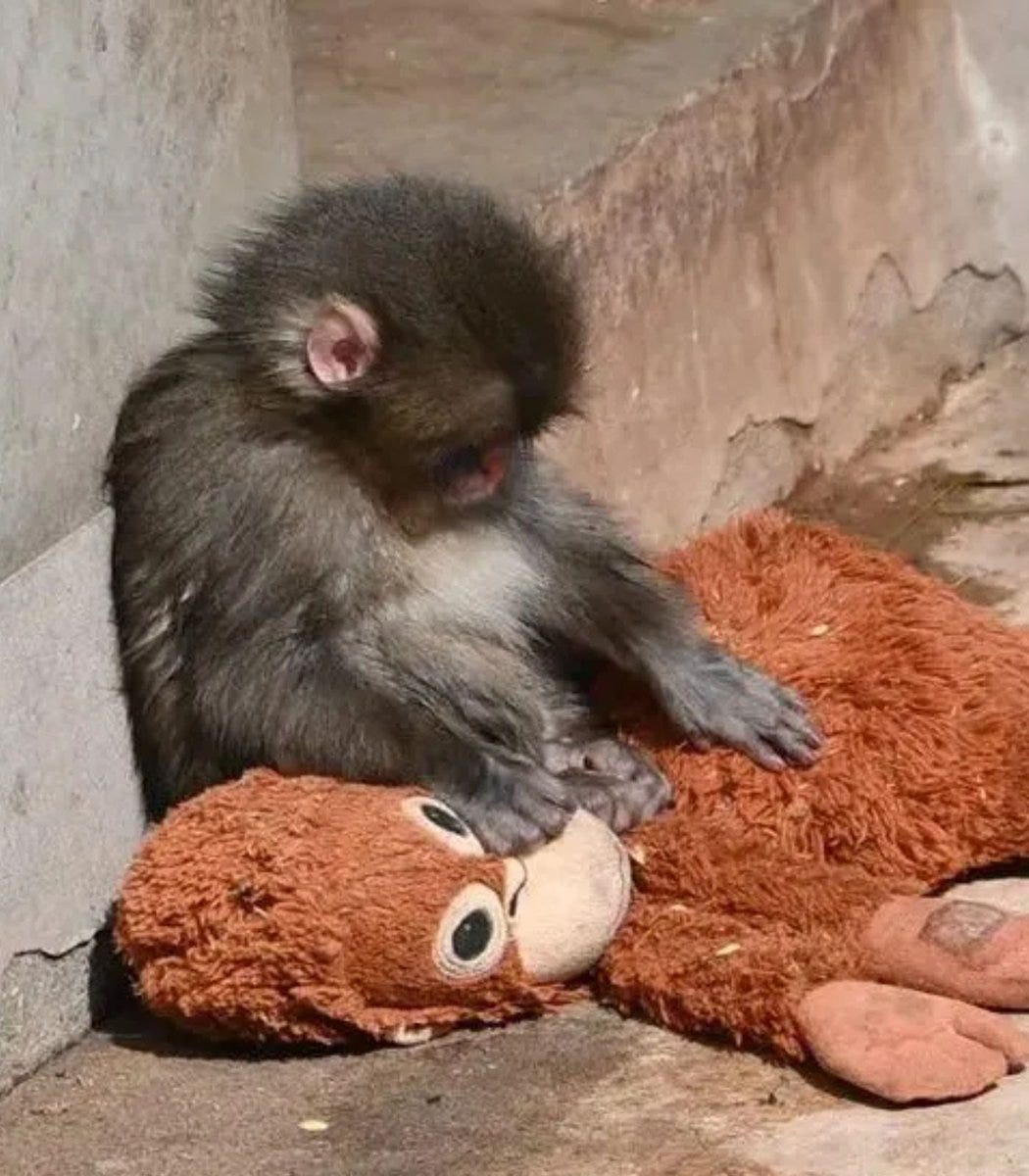
Panchi’s first giant win.
Panchi was accepted into his group. You may protest and say you’ve seen Panchi get beaten up.
Let me tell you, if that group didn’t want Panchi there, he wouldn’t be there. Macaques are known scrappy fighters. In captivity, when fleeing isn’t an option like it is in the wild, macaque monkeys can die due to aggression from their peers if caretakers don’t play close attention—and intervene if things get out of hand.
This group did not beat Panchi up, wound him, or kick him out.
That’s a win.
The “worst” video I’ve seen was one in which an adult female, whose baby Panchi had annoyed, grabbed Panchi, rolled him around a bit, and tossed him. Panchi was unscathed. The action itself looks bad—if you’re a human. It looks painful. It looks mean.
It’s none of those. These monkeys are sturdy and they communicate very directly with each other.
That other mama told Panchi to knock it off, and then sent him on his way.
Similarly, other adult monkeys have corrected Panchi’s behavior by swatting at him or swiping at him. These are incredibly normal corrective behaviors.
Like telling a small human they cannot run into the middle of the road. Or that they can’t just shove another child.
Panchi is learning how to be a monkey, but we can absolutely admit that Panchi has some extra hurdles in his way.
Rank matters
Panchi entered the group with pretty much no rank, placing him squarely at the bottom of the hierarchy.
Why?
Japanese macaques are a matrilineal species, meaning the women rule all. Within a macaque group, there’s a hierarchy of female monkeys. The alpha female ranks highest, followed by her daughters, in reverse birth order (youngest is highest ranking). Then comes the beta female and her daughters, then the gamma female and her daughters, and so on.
While male macaques are larger, more armored (their canine teeth are huge), and usually more outwardly aggressive, the females actually hold all the power.
The female matrilines determine where males rank. They pick the alpha male, and their tolerance of his choice of beta male and gamma male is required in order for the alpha male to pick his “guys”.
To avoid inbreeding, it’s common in multi-male, multi-female primate groups for one sex or the other to disperse upon reaching sexual maturity. When baby boys are born into a Japanese macaque group, they temporarily inherit their mothers’ rank, but—importantly—male macaques eventually leave their natal social group.
So, all this to say, Panchi-Kun is:
a male monkey
a young monkey
an orphaned monkey
With no relatives or kin within the social group, Panchi’s starting out with the lowest rank of the entire social group.
He’s got huge odds against him, and he’s got to learn how to be a monkey in order to stay within the group.
But, get this… he’s doing pretty well despite his low rank. He’s often seen on the outer edges of the enclosure, which is to be expected given that the higher-ranking monkeys often congregate centrally.
However, Panchi’s social prowess is being slightly dinged by an important additional factor…
His caretaker
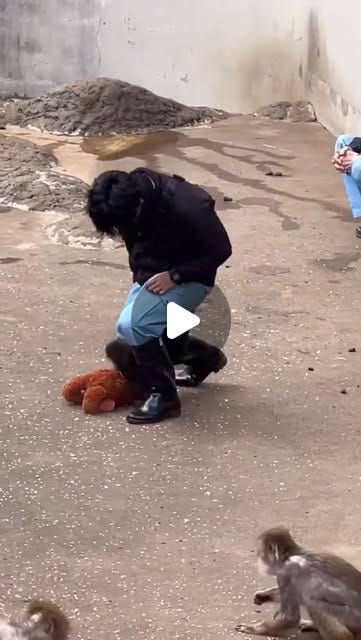
It’s obvious to me that the person whom Panchi consistently jumps on and clings to is likely the caretaker who raised him.
This caretaker is careful not to interact with Panchi too much, for good reason. As part of caring for nonhuman primates, it’s important to maintain healthy boundaries between ourselves and the monkeys. Ideally, we (those of us with the privilege to work directly with nonhuman primates) encourage “species-typical” behaviors, making sure monkeys keep behaving how monkeys should. Part of that includes us discouraging acting like tiny humans.
These boundaries include not petting the monkeys, not hugging them, not initiating physical contact first, and, if the monkey initiates contact, discouraging it by being very boring.
Given the fact that Panchi was likely raised by this caretaker, it’s understandable that there’s a bond there. It’s very heartwarming and sweet to see, as it reassures us that the caretakers here at this zoo are providing wonderful care. Believe me, nobody will be as honest about whether or not they like their caretakers as macaque monkeys.
They don’t keep their emotions under wraps.
Panchi’s biggest problem
Panchi’s attachment to his caretaker and his orangutan plush are two of Panchi’s biggest hurdles when it comes to assimilating into his group.
Simply put, he’s being weird.
Imagine if you saw a teenager walk into a grocery store dragging along a life-sized mannequin, and then that teenager jumped into the arms of the grocery store cashier and refused to let go.
You’d probably just stare in confusion. It’s not wrong, it’s just not… right…
That’s the odd behavior that’s Panchi’s performing right now.
And that’s why every small social interaction that Panchi navigates correctly (in macaque terms) matters so much.
Another monkey groomed him—that was HUGE. That’s social acceptance.
The fact that other monkeys are allowing him to sit near them? That’s massive.
While Panchi hasn’t been “adopted” by any one mother (he’s beyond the age of adoption), he’s being included in the social group the way that any young monkeys his age should be. He’s being taught how to be a monkey.
A note on captivity
I’d be remiss if I didn’t mention the lack of greenery in Panchi’s enclosure, as that’s something I’ve seen concerned individuals (and extremist groups) calling out.
There’s two things important to mention.
Macaques eat anything and everything. They likely mow down all greenery offered to them, as it’s a high value, yummy food.
For a species as… messy… as macaques, it’s often imperative that enclosures are easy to clean. A lot of monkeys generate a lot of poop.
Panchi’s success story
The fact that Panchi is being ingratiated into his social group is a massive win. Each day, we see him interacting with and sitting near more monkeys, and navigating the social hierarchy with increasing ease.
The little guy’s going to be okay. He’s learning some valuable lessons, and your adoration and love for him is justified. He’s a cute little guy with a bright future.
So those of you suggesting we enlist military force to rescue Panchi and destroy his bullies… stop being a helicopter parent.
Our boy is growing up and he’s going to be okay.
If you have questions, plop them in the comments or message me directly. I’m here to answer :)

This is the kind of stuff I talk about all the time here on Monkey Girl. Subscribe if you want to learn more about the monkeys I work with personally, what goes on behind the closed doors of a research facility, why Elon Musk shouldn’t be let anywhere near monkeys, and why the promise of a monkey sanctuary is actually complete garbage.
Subscribe for free or consider a paid subscription—I write about monkeys, love, and the messy parts of rediscovering and reclaiming your identity as an adult.
But seriously—if you have questions about Panchi, or any monkey, hit me up. That’s what I’m here for.
👋🏻 Meet your Monkey Girl
Hi, I’m Allison aka Monkey Girl—a published author, PhD scientist, and trusted book editor.
I’m reclaiming my story, one chapter, one essay, one monkey at a time. Read the latest chapters of my romcom Love Letter to Wanderlust every Monday, and keep your eyes peeled for my 👣 Path to Published series on Wednesdays. I share longer essays on the weekends—sometimes Fridays, sometimes Sunday mornings.
When I’m not typing away at my computer, I’m usually on a plane with my husband and toddler, or defending my three very patient cats from my very excited toddler.

Thanks for being here, truly. If you have thoughts, questions, anything, send me a message. I read every word and I’d love to hear from you.
Photography by the brilliant c.m.elle studios.
Allison! Thank you for this! Thank you for gently reminding us that monkeys, in this case, are just being monkeys and stop applying our human ways to what's happening here. It's so interesting to observe with something like this the extreme reactions people are having. They are reacting without knowing all the details, like you so articulately provided. It's also just as interesting to recognize how much calmer I feel after getting more context from someone who knows a ton and studying a ton of monkey behavior. Thanks for being the monkey voice of reason :) Keep writing!
Love that you cut through all the noise on this one!